

There is No Longer a Wildfire “Season” It’s a Year-Round Event
The wildfire “season” has now become a year-long event that requires more resources and support from structural firefighters. Historically the wildfire season had been between June and August in the US, during the dry and hot months. Now this “season” is affecting many different areas of the country with devastating results. This was especially true in 2021.
 Wildfire Season: January through December
 Wildfire Season: January through December
An unfortunate example of a year-round event was in 2021. In mid-January, wildfires started in the southern area of the west, fueled by dry conditions and Santa Ana winds. The wildfires continued throughout the year, finishing the “season” in the afternoon of December 30 with the Marshall fire in Colorado. This final fire of 2021 burned more than 1,000 homes in just a few hours.

2021 Totals for Wildfires
In total, 7 million acres burned and 6,000 structures were destroyed. It is estimated that $90 billion in damages occurred. Climate change is considered the biggest cause of these events.
Climate Change: Warmer Temperatures & Long-Term Droughts

According to statistics from the National Interagency Fire Center (NIFC), the number of acres burned by wildfires over the last 30 years has more than doubled. Due to long-term drought (the worst in 1,200 years) and warmer temperatures caused by climate change, the NIFC predicts this trend of year-round wildfires will continue with more frequency and intensity.

2023 Wildfire Season Losses
The National Interagency Fire Center reported that in 2023 there were 56,580 wildfires compared to 68,988 wildfires in 2022. Wildfires consumed 2,693,910 acres nationally, compared to 7,577,183 acres in 2022. The Eastern Area was the only Geographic Area to see above-average (56%) acres burned. All other geographic areas were below their averages for both number of fires and acres burned. A total of 4,318 structures were reported destroyed by wildfires in 2023, including 3,060 residences, 1,228 minor structures, and 51 commercial/mixed residential structures. In 2023, the majority of structures were destroyed in the Northern California Geographic Area, including the 2,308 residences destroyed in Maui.
 Preparedness & Training for the Structural Firefighter
 Preparedness & Training for the Structural Firefighter
Fortunately, 2023 wasn’t like the 2021 wildfire season. However, it’s always important to be prepared. As we have seen, the wildland fire management environment has profoundly changed. Bigger and more extreme fires with more acres burned each year. In addition, crowded urban areas and residential neighborhoods have sprawled and expanded into rural, intermix, and wildland spaces. This creates some complex challenges for structural firefighters if they don’t have the knowledge or training to operate in these environments.

Current Fire Statistics for This “Season”
Current statistics for 2024 from the National Interagency Fire Center can be viewed here: https://www.nifc.gov/fire-information/statistics
WUI Fires Present Complex Challenges for Structural Firefighters

Wildland Urban Interface (WUI) fires present a complex and unique set of challenges for both wildland and structural firefighters. Firefighters who traditionally respond to structure fires need to understand the environmental effects on their firefighting operations and structure protection. Recognizing risks and guarding against unsafe behaviors will help protect firefighters when responding to WUI fires. Training and skills practice can help to reduce firefighter risk.
Meeting Training Requirements – WUI Firefighting Requires Unique Skills & Knowledge

Action Training Systems has a 7-title series to help firefighters who are trained to the requirements of NFPA® 1001 and may be called to assist with operational activities at wildland or Wildland Urban Interface fires. This series can help fire service agencies and members meet the training requirements of NFPA 1051 and 1143, as well as USFA/FEMA’s Skills Crosswalk, Wildland Training for Structural Firefighters.

Referenced sources and learning objectives include the National Wildfire Coordinating Group (NWCG) and the National Interagency Fire Center (NIFC).
ATS Series – Wildland Urban Interface Firefighting for the Structural Firefighter
 The learning objectives in the ATS WUI series include identifying fuels, forecasting fire behavior, and understanding weather and wind effects in the WUI environment. Skills include size-up considerations, fire control strategies, creating firelines, performing structure triage, and hazard control.
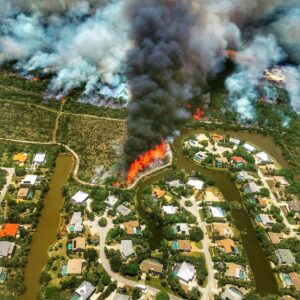
Hazard mitigation and scene safety are emphasized including tool and equipment use, thunderstorm safety, last resort survival, vehicle, and aviation safety.
Tools For the Instructor
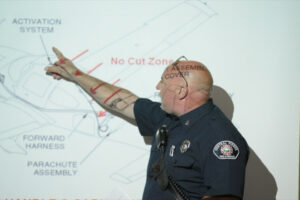
This series, “Wildland Urban Interface Firefighting for the Structural Firefighter” is intended to be used by certified instructors and designed to be integrated into a broader curriculum that includes classroom instruction, hands-on practice, and the use of other educational materials. Instructor support materials include a Facilitator Guide with outlines, student handouts, quizzes, and skills suggestions. PowerPoints are available for each title. Titles can be delivered as interactive courses, on DVDs, USB, or as online streaming media.
More At Risk Means More to Lose In WUI Firefighting
 Even with extensive training, fighting wildfires is a dangerous activity for firefighters from all types of agencies.
The NFPA reported that 50 percent of all firefighter fatalities that occurred in 2020 were at wildfire incidents. Studies have also found that the WUI environment raises the stakes even higher because there is so much more at risk. Training is key to firefighter safety.
Training & Preparation Are Key For Wildland/WUI Firefighting
 Population shifts, patterns of development, and droughts due to climate change are all significant factors that will continue to shape wildfire seasons into longer, more intense, and unpredictable events. Preparing your community and training your firefighters are critical components of firefighting response.
For more information about Action Training Systems or the “Wildland Urban Interface Firefighting for the Structural Firefighter” series please visit www.action-training.com

Additional Resources & References:
- https://www.popsci.com/environment/the-american-west-is-primed-for-a-summer-of-fire/
- https://www.predictiveservices.nifc.gov/outlooks/monthly_seasonal_outlook.pdf
- https://www.popsci.com/science/spring-earlywildfire-season-climate-change/


