
Guest Blog written for ATS by Robert Avsec
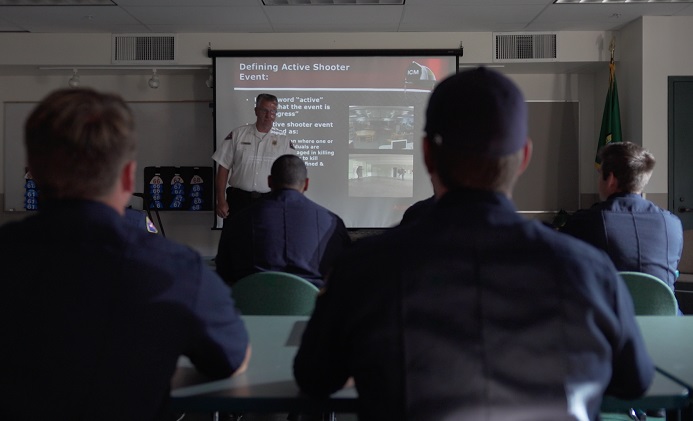 Many firefighters “have the patch and the t-shirt” indicating that they’ve successfully completed a fire service training course. Regardless whether the course was an instructor-led session (traditional classroom) or an on-line training course, the key question is: can the individual successful apply their newly acquired knowledge and skills to real-world practical situations?
Two different words, two different meanings
Compliance training is designed to be as efficient as possible. That means the training is inexpensive, quick and non-disruptive to normal operations. Competency-based training, on the other hand, is designed to be as effective as possible. That is, it works. Real learning becomes possible.
Why is compliance-based training not effective? First, it is required, which causes resentment—a “teach me if you can” mentality on the part of the student.
Compliance training tends to start with the assumption that the student is “guilty” (of discrimination, poor work performance, etc.) until proven “innocent.” And that causes defensiveness on the part of the student.
Most compliance training also involves testing, which causes stress for the student. Resentment, defensiveness and stress do not create a good atmosphere for learning to take place. Compliance training can even do more harm than good.
“Practices that target managerial bias through diversity training show virtually no effect. In fact, research to date suggests that the training often generates a backlash.”—Professor Frank Dobbin, Harvard University.
Differing Goals for Training
In many cases, fire departments carry out compliance training in order to meet a regulatory requirement (OSHA regulation) or fire service standard (NFPA professional qualifications). Training must be seen to have taken place. Real learning is a bonus.
It’s probably a safe assumption that fire department’s goal when providing training to their people, or require that individual members obtain required training outside of the department, is to increase the individual’s level of competence to do a job safely, effectively and efficiently (SEE).
The “rub” is that the goal for the individual in many cases is to complete the required training with as little effort as possible. Get it over with, get the “box checked” and move on. In other words, be compliant with the department’s requirement.
Why competency matters
The goal of occupational training should be for the individual to acquire new knowledge, skills, and abilities. The desired result is the individual’s capability to do a new job or improve their job performance in their current job. Good training answers two very pertinent questions for the adult learner “up front”:
• What’s in it for me?
• How will this training help me to do my job better?
The acquisition of new knowledge and skills are both important. However, the organization and the individual truly benefit when training results in the ability of the individual to apply their new knowledge and skills to real-world situations and problems.
6 Steps for training that promotes competency
For fire departments looking to ensure competence, i.e., that real learning can take place, the following actions are a good place to start:
• Provide positioning—a rationale for the training—as well as covering the underlying concepts and principles.
• The training should present policies and procedures clearly and simply.
• The training should require the students to work through real-world examples.
• The training should allow the learner ample opportunity for practice, safe from danger, and from the risk of embarrassment. Training simulations and scenarios are useful tools for this purpose.
• The student should be supported in applying what they’ve learned to their job, perhaps by coaching, by reference information available on demand, or through communities of practice.
• Fire department leaders need to reinforce the new behaviors by modeling the skills themselves and by providing positive reinforcement to their direct reports.
References
Shepherd, C. (2009, November). Competency or compliance – you choose. Retrieved August 10, 2016, from http://www.slideshare.net/clives/competency-or-compliance-you-choose
Thalheimer, W. (2010, April). How Much Do People Forget? Retrieved August 10, 2016, from http://www.work-learning.com/catalog.html
 Battalion Chief Robert Avsec (Ret.) served with the Chesterfield (Va.) Fire & EMS Department for 26 years. He was an active instructor for fire, EMS, and hazardous materials courses at the local, state, and federal levels, which included more than 10 years with the National Fire Academy. Chief Avsec earned his bachelor of science degree from the University of Cincinnati and his master of science degree in executive fire service leadership from Grand Canyon University. He is a 2001 graduate of the National Fire Academy’s Executive Fire Officer Program. Since his retirement in 2007, he has continued to be a life-long learner working in both the private and public sectors to further develop his “management sciences mechanic” credentials. He makes his home near Charleston, W.Va. Contact Robert atRobert.Avsec@FireRescue1.com


