
Guest Blog written by Robert Avsec for Action Training Systems
 The training and development of its people is one of the critical functions that any fire department must conduct. Without good entry-level training and continued training of its incumbent staff, a fire department will be hard-pressed to deliver high quality emergency services in a safe, efficient, and effective manner.
The challenges in delivering that training are greater than ever before. Reductions in funding for training, reductions in available instructors, and increased training requirements are just a few of those challenges that fire department leaders face.
The good news is that all training and development does not have to originate with the Training Division. Individual officers within the organization can enhance the department’s overall training by taking ownership for the training and development process. This is especially true for the continuing training of incumbent staff.
Where to start?
Get your hands on a copy of the 2013 edition of NFPA 1001: Standard for Fire Fighter Professional Qualifications. There’s not a better roadmap to use in developing and delivering training so that your department’s fire fighters will be ready to meet job challenges. NFPA 1001 identifies the minimum job performance requirements (JPRs) for career and volunteer fire fighters whose duties are primarily structural in nature; the standard addresses the job performance requirements for both Fire Fighter Level I, and Fire Fighter Level II.
Before delving right into the meat of the standard, do yourself a favor and read through Annex B of the standard, Explanation of the Standard and Concepts for JPRs. The information contained in the Annex will help you to gain a better understanding of how JPRs were developed and how your training can address those JPRs.
When developing training and development activities for incumbent staff, keep in mind that you want to focus less on teaching knowledge and skills (they should already have that by virtue of being certified as a Firefighter Level I or Level II. Instead, put your time and energies into creating training drills that make them to remember what they’ve previously learned and develop their abilities to use what they’ve already learned.
SMART Objectives
Developing good training objectives is a critical component for developing and delivering safe, effective, and efficient training for your people. The acronym SMART stands for:
• Specific
• Measurable
• Attainable
• Realistic
• Time specific
So let’s take a look at how you can develop a training plan beginning with a SMART objective.
Objective: Given that firefighters are certified to HazMat Operations Level, all firefighters will be able to respond safely, effectively and efficiently to a hazardous materials spill involving an over-the-road tank truck by February 15, 2017.
So how does that training objective match up with SMART?
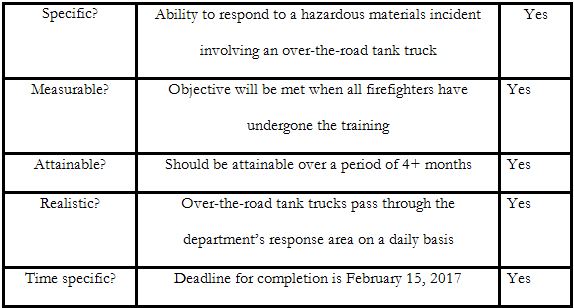
Strategies to meet the objective
Now granted, that can seem like a pretty big objective, right? Well not if you break the necessary training and drilling down to their component parts.
• Conduct training classes to review use of the North American Emergency Response Guide (the Orange Book) for product ID and hazard characterization with completion by October 1, 2016.
• Conduct drills to review donning and doffing of personal protective equipment by November 1, 2016.
• Conduct drills to review emergency Stage I Decon and Stage II Decon skills by December 1, 2016.
• Conduct drills to review use of defensive tactics for spill control by January 1, 2017.
• Conduct a full department drill using an over-the-road tank truck (Arranging to have such a vehicle with a local vendor) leaking water to simulate a liquid hazardous material spill by February 15, 2017.
Monthly scheduling to accomplish training strategies
Now, all that is necessary is to schedule the required number of training/drills to accommodate the target population of firefighters each month. In a small department, one session each month may be adequate to get all personnel through the training and drill subject for that month, e.g., “reviewing the use of the North American Emergency Response Guide (the Orange Book) for product ID and hazard characterization by October 1, 2016.”
Larger departments might find it more advantageous and more accommodating for their personnel to schedule several offerings of the same training/drill during the month at different times. Perhaps a good option for a volunteer department that has members who work shift work would be to schedule two sessions at night (to accommodate those who work during the day) and two sessions during the daytime (to accommodate those who work during the night).
Keeping your people trained and ready to do the job does not have to be a laborious and time-consuming task, but it does require planning and coordination. Keep in mind the adage, “People don’t plan to fail, they fail to plan.”
For more information on Action Training Systems video resources call 800.755.1440 ext 3 or email info@action-training.com
 Battalion Chief Robert Avsec (Ret.) served with the Chesterfield (Va.) Fire & EMS Department for 26 years. He was an active instructor for fire, EMS, and hazardous materials courses at the local, state, and federal levels, which included more than 10 years with the National Fire Academy. Chief Avsec earned his bachelor of science degree from the University of Cincinnati and his master of science degree in executive fire service leadership from Grand Canyon University. He is a 2001 graduate of the National Fire Academy’s Executive Fire Officer Program. Since his retirement in 2007, he has continued to be a life-long learner working in both the private and public sectors to further develop his “management sciences mechanic” credentials. He makes his home near Charleston, W.Va. Contact Robert at Robert.Avsec@FireRescue1.com


