
 Guest Blog written for ATS by Robert Avsec
Kind of a misleading title, don’t you think? Because as we continue to venture forth into using online platforms to deliver fire and EMS training, don’t you need to be more than an instructor?
Certainly, in the traditional sense of the word, instructor. And most certainly in the context of instructor-led training. Previously, instructor-led training meant having an instructor physically present before students in a classroom. We now have an expectation that those same instructors become proficient at leading the delivery of online training and education.
We also have an expectation that instructors become equally proficient in leading their on-line students through: online knowledge acquisition; the skills development phase; and the ability to apply the knowledge and skills. Here are four steps that can help you to become that kind of instructor.
1. Learn what your students are learning
Go through the online training program that your students will be using before they can sign up for the training. Make sure that the delivery platform (what we used to call software before the “cloud”) works as it should and minimize the potential for students to encounter roadblocks (You may or may not have been part of the process to select the online training platform that will be used, but you’re darn sure going to be the one dealing with the emails and phone calls from your students if problems do arise).
Older students still may not be comfortable with new learning technology and might be easily frustrated by glitches early in their experience. More tech-savvy students may lose confidence in a training delivery service that they consider “lame.”
You want to be sure that you know and understand what knowledge your students are learning through their online course work. Don’t count on it being 100 percent in line with what you may have learned when you were in your students’ position (The times, they are a changing!).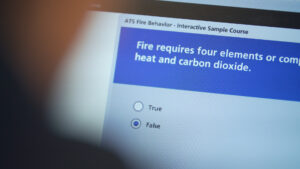
Knowing exactly what your students are learning online will help make your practical skills development sessions more productive. You’ll get more done each session if you don’t have to constantly deal with statements like this, “But that’s not what I learned online!”
2. Set clear expectations upfront
Be sure to reinforce to your students that it is their responsibility to complete the required online training modules and arrive at the skills development sessions fully prepared to learn practical skills and practice them to proficiency. Your ability to deliver safe, effective and efficient skills training sessions is going to be predicated on all your students having acquired the requisite knowledge online beforehand.
Set hard and fast deadlines for completion of the requisite materials that each student must complete to be eligible to participate in the skills development sessions. Give yourself and your students a buffer by making the deadline at least 48 hours before the scheduled skills session.
Online learning platforms have administrative dashboards that enable authorized personnel, e.g., the course administrator and lead instructors, to view individual student progress for course modules or chapters. Make sure that prior to the day of the skills development session you have confirmation that all students have met the deadline.
Make sure you contact any students that have not met the deadline and inform them that they will be unable to participate unless they complete the required modules or chapters. This is where that time buffer can come in handy.
 We always want to make sure that every student has the opportunity to get the training, and there has to be individual accountability as well. Whatever you do, don’t let a student participate who’s not met your prerequisite requirements. Doing so will only damage your reputation as an instructor with your other students.
3. Be sure to teach what the students have learned
This is another reason why Step #1 is so important. You must ensure that your skills development session is congruent with what the students have learned on-line. Pay attention to the “optics”: their knowledge of what they expect to see on the drill ground is based solely upon what they saw on their computer screen or tablet. So, make sure that the equipment you’re using and the methods you’re teaching them look familiar to them (This is another opportunity to eliminate the, “That’s not how they showed it in the video,” statements on the drill ground).
4. Stay focused on skills development
This is where Step #2 becomes so important. You should hold your students accountable for having acquired the requisite knowledge during their online studies. Don’t teach knowledge content on the drill ground; teach skills development and give every student the opportunity to practice the skills they’ve learned to gain proficiency.
 Failure to do this will usually result in resentment on the part of those students who did what was expected of them. It will also reduce the amount of time available for teaching and practicing the skills. And isn’t that the real purpose of the skills development session?
The effective and efficient use of time during skills development sessions only becomes more critical as your training program moves beyond teaching single practical skills, e.g., how to advance hoselines or raise ladders, to more complicated scenarios, such as, advancing hoselines up and down ladders. So, create consistent expectations for your students about what they’re going to be doing during skills development sessions when all of you are working on the simple stuff.
I firmly believe that any good instructor can become an even better instructor, as they gain experience with blending online learning with practical skills development, by following these four steps. I also believe that instructors who follow these steps will find that their practical skills development sessions will not only be more effective and efficient, but more fun as well for everyone. I’ve always said, “If you’re not fighting fires, you should be training to get better at fighting fires. And have fun while you’re doing it.”
For more information on Action Training Systems video resources call 800.755.1440 or email info@action-training.com
 Battalion Chief Robert Avsec (Ret.) served with the Chesterfield (Va.) Fire & EMS Department for 26 years. He was an active instructor for fire, EMS, and hazardous materials courses at the local, state, and federal levels, which included more than 10 years with the National Fire Academy. Chief Avsec earned his bachelor of science degree from the University of Cincinnati and his master of science degree in executive fire service leadership from Grand Canyon University. He is a 2001 graduate of the National Fire Academy’s Executive Fire Officer Program. Since his retirement in 2007, he has continued to be a life-long learner working in both the private and public sectors to further develop his “management sciences mechanic” credentials. He makes his home near Charleston, W.Va.


