
 Guest blog written for ATS by Robert Avsec
Where to start? Tackling such a broad topic in your fire department might seem like trying to get a drink of water from a fire hose, no? Well, how about we take that water flow down to water fountain-size and get a good drink!
Let’s start with us
Firefighters and fire officers can be their own “worst enemy” when it comes to safety. In his outstanding book, I Can’t Save Your Life, But I’ll Die Trying, Dr. Burton Clark, a long-time advocate for safety in the fire service tackles the emotional topic of our fire service culture.
In his collection of essays written over his 40+ years in the fire service, Dr. Clark shows how the risk-taking culture of the fire service contributes to preventable firefighter deaths and injuries. For example, too many firefighters still don’t use seatbelts when responding to, and returning from calls.
“Motor vehicle crashes are the second-leading cause of firefighter fatalities in the United States and this effort aims to reduce the number of preventable fatalities. Just as you need to get to the scene of a call quickly, you need to get there safely; buckling your seatbelt is the easiest safety measure you can take.” Chief Ronald J. Siarnicki, Executive Director of the National Fallen Firefighters Foundation
Have you and your department taken the National Seatbelt Pledge?
Are you and your department taking advantage of the information coming from fire behavior research conducted by the United States Fire Administration, the National Institute of Standards and Technology, and UL? This research is “exploding” many long-held beliefs about fire behavior and how we fight fires. Transitional fire attack, aka, “hit it hard from the yard”, is just one example of how research is giving us the information we need to do our jobs more safely.
See Related: UL Firefighter Safety Research Institute (Video)
Prevention-centric focus
Firefighters, be they career or volunteer, are widely respected and admired in communities across the U.S. and Canada. You and your brother and sister firefighters have earned that trust primarily through a suppression-centric focus—all those things you and your department do to prepare for and carry out fire suppression tasks. But it’s time to move in another direction.
Too many fire departments are operating today with too few firefighters. Career departments are laying off personnel due to budget cuts. Volunteer fire departments are seeing their member rolls in decline and are having difficulty attracting new members. And we still have too many preventable fires happening in our communities with too many preventable deaths and injuries to civilians.
We must move towards a more balanced approach. One where a prevention-centric focus is just as important for a fire department as its suppression-centric focus. The fire and life safety education programs for many fire departments—if they even have one—are woefully inadequate. Fire station tours, giving out plastic firefighter helmets and Junior Fire Marshal stickers are not effective fire and life safety education.
A great example of what a good fire and life safety education tool looks like is the “Fully Involved” Home Safe Teaching System from Prevention Connection International. This teaching tool—which fits in the trunk of most automobiles—provides a consistent teaching tool that can be used by firefighters and non-firefighters alike to teach children how to avoid becoming a victim of fire.
Children don’t cause fires, adults do
The reality is that the behaviors of adults in the USA account for 78 percent of the preventable residential fires.
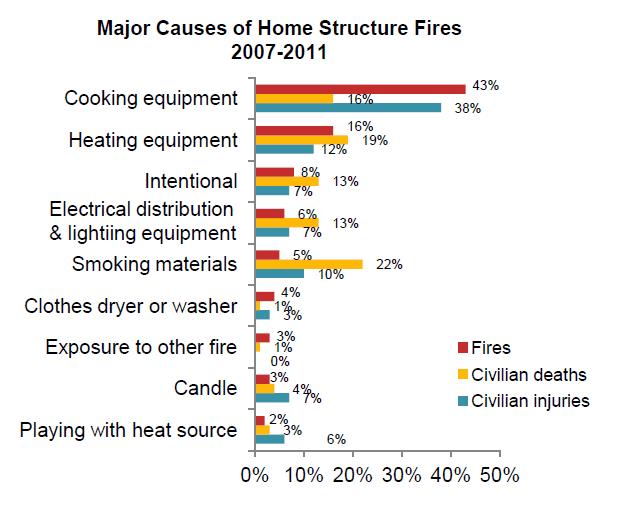
Source: NFPA.org
I don’t know about you, but I don’t see the “fingerprints” of children on these fire causes. Sure, there are situations where children are involved in the cause of the fire, e.g., the child may be the one cooking or using the heating equipment, but I submit that the base cause is likely one of the following adult behaviors:
• An adult was not properly supervising the child while the child was cooking;
• An adult had not taken the proper measures to ensure that the child could not gain access to the heating equipment, e.g., putting up a screen around a kerosene-fueled heater; or
• An adult left smoking materials, e.g., a lighter or matches, unsecured and accessible to the child.
Adults, not their children, should have the knowledge and skills to be the household “leaders” for items such as, but not limited to, the following:
• Ensuring the home has working smoke detectors 24/7/365;
• Developing and practicing E.D.I.T.H. (Exit Drills in the Home) with the entire family;
• Safe cooking practices and rules for children when cooking;
• Proper storage and use of flammable materials; and
• Proper use of portable space heaters.
See Related: Fire + No Working Smoke Alarm in Your Home = You’ll Die
Basic fire dynamics
The average adult is largely ignorant of how quickly a fire can develop and make a space untenable for human life. Those adults have unrealistic expectations about (1) their own ability to safely get themselves and their family out of a dwelling fire, and (2) the ability of their local fire department to respond and safely, effectively, and efficiently rescue them and protect their property.
Twenty-five years ago, NFPA® created the award-winning video – Fire Power – which takes a firsthand look at the deadly dynamics of fire from ignition to full room involvement. Here is the updated version of that video from NFPA.
Social media outreach
Everyone is busy these days. And to become more effective and efficient in informing and educating the citizens we serve about how to protect themselves from fires and other preventable deaths and injuries, we must make greater use of social media platforms, e.g., Twitter, Facebook, and Instagram.
We change people’s behaviors, not by trying to change the individual’s behavior (appealing to their intellect) but rather by having a positive influence on their perceptions about how others see their behavior (our desire to be “normal”). It’s a self-reinforcing process. That’s why fire prevention efforts are so much more effective in countries like Japan or Germany: people don’t want to be the “bad person” who had a preventable fire that threatened the community.
We can use social media to reach our citizens 24/7/365 to inform and educate them to believe that fires are “not the social norm” (unavoidable), but rather the “wrong thing” (because someone’s behavior caused the fire). What if we used social media to:
1. Highly publicize all fire incidents as they occur in the community and include the cause of the fire. Many law enforcement agencies already do this, to some degree, by having details of weekly crimes in the community published in the local newspaper, e.g., Police Blotters. People can read about what crimes are being committed where in their community.
2. Regularly highlight fires and include information on how the fire should have been prevented. For example:
a. Fires that threatened other properties;
b. Fires that required full commitment of a department’s fire suppression resources and how that potentially could have had a negative impact on service delivery to other calls; and
c. Fires that resulted in civilian and/or firefighter casualties.
3. Include a pertinent fire safety and prevention message on how the fire should have been prevented.
I realize that was a very quick take on using social media, but that’s another topic in and of itself. Even if you’re already using social media for fire department communication to the public, can you see how you can sharpen your messages? And if you’re department’s not using social media, these are the types of messages you want to created and convey using social media.
For a great set of resources to help you and your department in crafting good fire safety messages using social media, check out the U.S. Fire Administration’s program, Fire is Everyone’s Fight.
For more information on Action Training Systems video resources call 800.755.1440 ext 3 or email info@action-training.com
 Battalion Chief Robert Avsec (Ret.) served with the Chesterfield (Va.) Fire & EMS Department for 26 years. He was an active instructor for fire, EMS, and hazardous materials courses at the local, state, and federal levels, which included more than 10 years with the National Fire Academy. Chief Avsec earned his bachelor of science degree from the University of Cincinnati and his master of science degree in executive fire service leadership from Grand Canyon University. He is a 2001 graduate of the National Fire Academy’s Executive Fire Officer Program. Since his retirement in 2007, he has continued to be a life-long learner working in both the private and public sectors to further develop his “management sciences mechanic” credentials. He makes his home near Charleston, W.Va.


