
National EMS Education Standards Impact on Training

**Prior to using the Education Standards or Curricula, you should contact your State EMS Office to see what versions are currently adopted and used in your State.
The National EMS Standards, or NEMSES, were developed by the National Highway Traffic Safety Administration to be implemented in 2010. The standards define the minimum level of knowledge and competency that must be met by EMS personnel. The objective of the standards is to develop educational core content at a national level for every level of emergency medical service providers operating in a pre-hospital setting. The standards reflect an industry consensus identifying the knowledge and skills necessary for providers in order to competently provide emergency medical service.
The standards are accompanied by instructional guidelines designed to provide assistance to instructors during the course of training. The guidelines operate as a companion resource to the standards and incorporate certain American Heart Association Guidelines as supplementary instructional content.
An instructor evaluating training materials to use when teaching to this standard should keep in mind the new guidelines regarding EMS training. The following are from page 59 of the standards document where the Education Infrastructure is outlined.
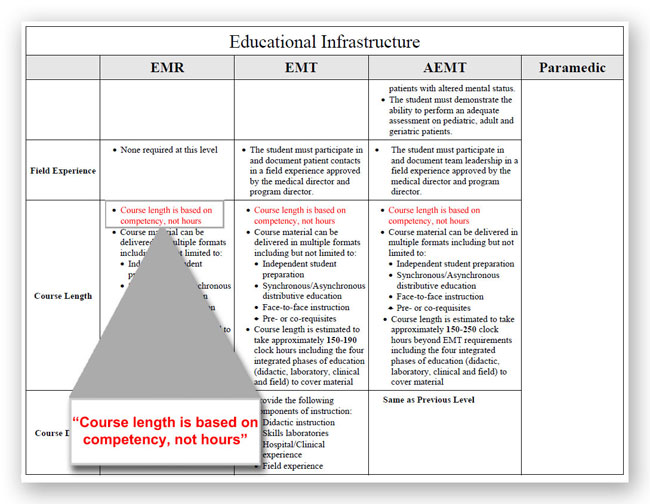
1) Course length is based on competency not hours –
A large number EMS training programs have focused on hours of instruction to help individuals meet a certification requirement as opposed to competency. NEMSES recognizes estimated hours for course length but is putting the emphasis on competency rather than hours. Training should be about maintaining or improving competency. As organizations move to adopt this new standard, training materials used in their training programs should be designed with this in mind.
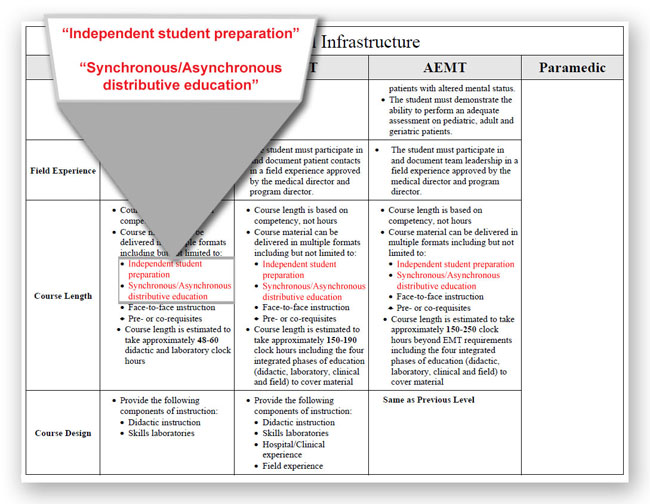
2) Course material can be delivered in multiple forms including but not limited to: Independent student preparation –
Allow students to prepare for hands on training or classroom on their own prior to attendance which ties in to the distributive education below.
Synchronous/Asynchronous distributive education –
Synchronous training involves real-time or “live” interaction with an instructor.
Asynchronous training allows students to train without real-time instructor interaction.
Asynchronous training can be facilitated or self-paced.
Facilitated asynchronous training requires a student to complete training on an instructor’s schedule. Student progress or completion of assignments is monitored by an instructor and feedback is given although it is not real-time interaction.
Self-paced asynchronous training does not require interaction with an instructor to complete and can be done on a student’s own schedule. Asynchronous computer-based training is more common as it allows for on-demand learning by the student. This allows the most flexibility for the student and can be particularly beneficial for continuing adult education.
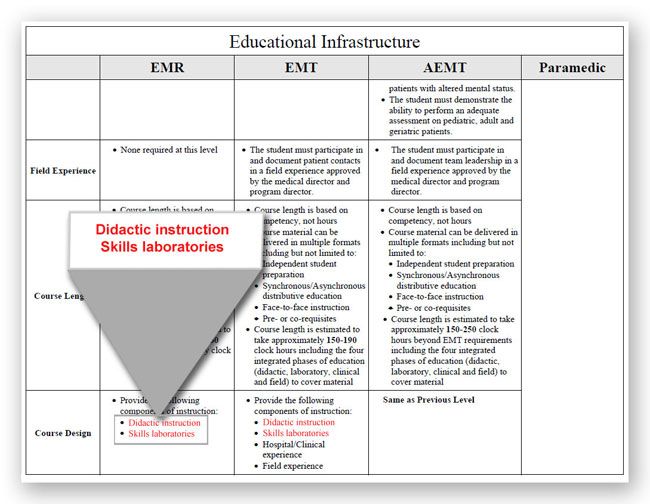
3) Provide the following components of instruction: Didactic instruction –
Didactic Instruction is the delivery of factual information to facilitate the acquisition of organized knowledge. This can be accomplished by means of lecture, demonstration, videos, and reading. The goal is for students to acquire the basic “must know information” about a subject.
Skills laboratories – Students practice and demonstrate hands on skills.
Action Training Systems Computer Based Training (CBT) courses and DVD programs are now and always have been instructionally-designed to be standards based and competency driven. Our CBT courses provide didactic, self-paced, asynchronous training to help students master core skills and prerequisite knowledge as it relates to national standards such as the 2010 National EMS Education Standards. Our first EMS series will be Emergency Medical Responder to be followed by Emergency Medical Technician.
For more information about NEMSES
 visit the: National Highway, Traffic Safety, EMS website


